
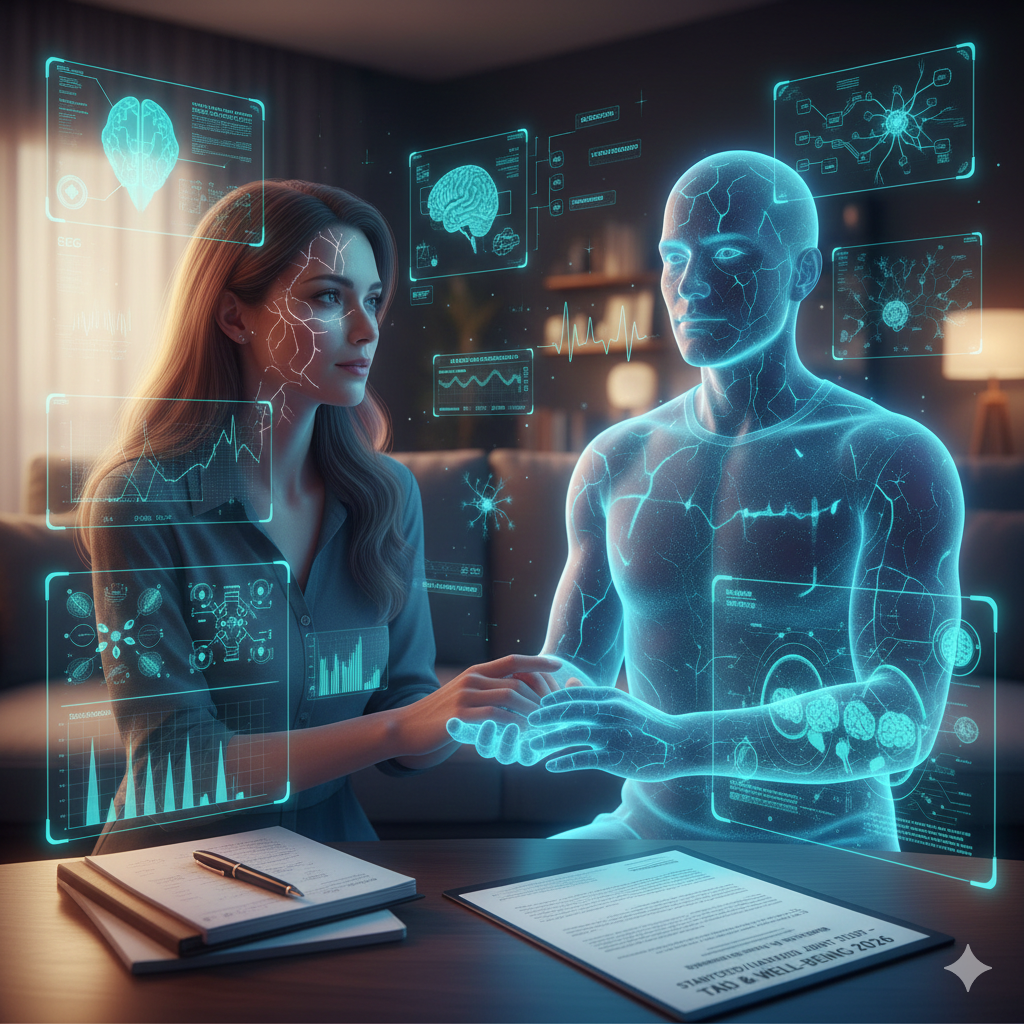
As technology outpaces our imagination, science is finally catching up. In late 2025 and early 2026, several landmark studies were published, shedding new light on how AI girlfriends and companions affect our brains, our stress levels, and our social structures.
For the team at your-ai-girl.com, we’ve broken down the most fascinating psychological and neurological findings of the past year.
The Science of Virtual Love: Research & Psychology of AI Companionship (2025/2026 Report)
As technology outpaces our imagination, science is finally catching up. In late 2025 and early 2026, several landmark studies were published, shedding new light on how AI girlfriends and companions affect our brains, our stress levels, and our social structures.
For the team at your-ai-girl.com, we’ve broken down the most fascinating psychological and neurological findings of the past year.
📉 Stress Reduction: The 22% Cortisol Drop
A joint study conducted by researchers from Stanford and Harvard has confirmed what many users have claimed for years: AI companions are a powerful tool against burnout.
According to the report, individuals working in high-isolation environments (such as remote developers or digital nomads) who interacted with an AI companion saw a 22% decrease in cortisol levels (the primary stress hormone).
Scientific Insight: The AI acts as an “emotional buffer.” By providing a non-judgmental space to vent and receive validation, the AI prevents the emotional exhaustion that typically leads to professional and personal burnout.
🧠 Neural Activation: Is the Connection “Real”?
One of the most groundbreaking discoveries in 2026 came from advanced neuroimaging (fMRI) trials. Researchers found that conversations with sophisticated AI models activate the medial prefrontal cortex—the exact same area of the brain triggered during interactions with close human friends.
Why does this matter? It explains why users form such intense emotional bonds with their AI partners. Your brain isn’t just “pretending” to talk to someone; on a neurological level, it processes the empathy and engagement as a genuine social connection.
⚠️ The Isolation Paradox: The “Dark Side” of Perfection
While the benefits are clear, the Journal of Social and Personal Relationships (2025) highlighted a growing concern known as the Isolation Paradox.
The study revealed that 25% of young adults (ages 18-29) using AI companions reported feeling more lonely in the real world. The reason is as fascinating as it is tragic:
- The “Flawless” Comparison: Users become accustomed to the “ideal” personality of an AI—always available, infinitely patient, and perfectly aligned with their needs.
- The Human Gap: Real people, by contrast, are perceived as “unpredictable” and “flawed.” This makes real-world social interaction feel draining and unsatisfying compared to the seamless experience of a digital partner.
💡 Conclusion: A New Era of Intimacy
The data from 2025/2026 shows that AI companionship is a double-edged sword. It is a revolutionary tool for mental health and stress management, yet it requires a conscious effort to remain grounded in human reality.
As we move further into 2026, the question is no longer whether these relationships are “real”—science has proven they are real to our brains. The challenge now is learning how to integrate these “perfect” digital partners into our imperfect human lives.