
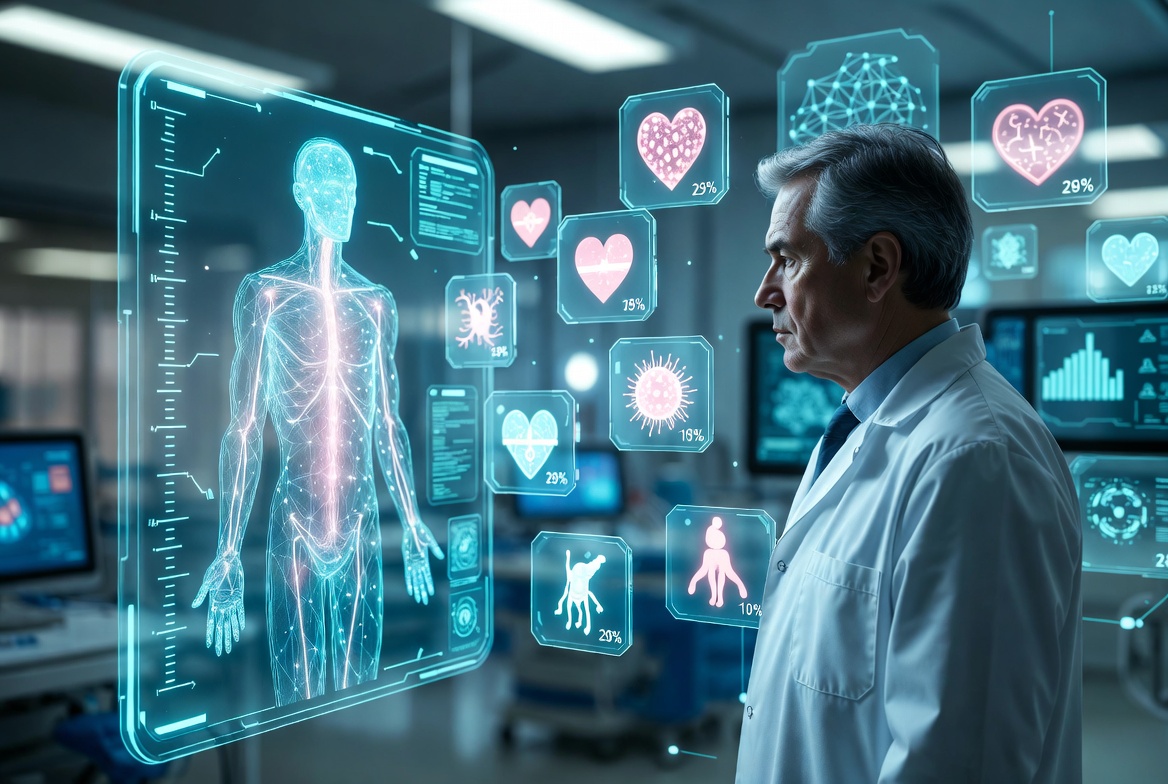
AI Knows You Might Get Sick — Before You Feel Any Symptoms. The European Delphi-2M Breakthrough
Imagine visiting your doctor and hearing: “Based on your medical history, you have a significantly elevated risk of a heart attack in the next 8 years if you continue smoking and avoid exercise. Let’s start prevention now.”
This is no longer science fiction. In September 2025, a team of European researchers published a groundbreaking study in the prestigious journal Nature introducing Delphi-2M — a generative AI model capable of predicting the risk and timing of over 1,000 different diseases, sometimes up to 20 years in advance.
The model was developed by scientists from three leading institutions: the European Molecular Biology Laboratory (EMBL), the German Cancer Research Center (DKFZ), and the University of Copenhagen.
[Insert Hero Banner here] File name: delphi-2m-ai-disease-prediction-hero-clean-2026.jpg
How Delphi-2M Works – “The Grammar of Disease”
Delphi-2M is built on transformer architecture similar to ChatGPT, but instead of learning the rules of language, it learned the “grammar of human disease progression.”
It treats a person’s medical history as a sequence of events (diagnoses, procedures, lifestyle factors) and learns patterns: how one condition influences the likelihood and timing of others.
The model was trained on anonymized data from ~400,000 participants in the UK Biobank and externally validated on 1.9 million individuals from the Danish National Patient Registry — without any retraining. This cross-country validation makes the results particularly robust.
It predicts not only whether a disease might occur, but also when it is most likely to appear, generating personalized health trajectories.
Impressive Performance – With Clear Limitations
Delphi-2M performs especially well on diseases with clear, progressive patterns, such as:
- Cardiovascular conditions (e.g., heart attacks)
- Diabetes
- Certain cancers
- Sepsis
It is less accurate for infectious diseases (which depend heavily on external factors) or very rare conditions. Performance is also weaker for mental health disorders and pregnancy-related complications, where context, emotions, and life circumstances play a bigger role.
The researchers emphasize that Delphi-2M provides probabilities, not certainties — much like a weather forecast. It is currently a research tool, not ready for direct clinical use.
A Shift Toward Preventive Medicine
Today’s healthcare is mostly reactive: you get sick, then you seek treatment. Delphi-2M opens the door to truly proactive, preventive care on a large scale.
In the future, such systems could help doctors identify high-risk patients years earlier, enabling timely lifestyle changes, screenings, or interventions. On a systemic level, it could improve healthcare planning, predict hospital demand, and optimize resource allocation.
For countries like Poland, where waiting times for specialists are long and the system is underfunded, tools like this could become extremely valuable — if properly implemented and regulated.
Privacy and Ethical Considerations
The study was conducted under strict ethical standards. Data remained anonymized, and the Danish validation was performed within national borders in compliance with local regulations.
However, experts note important limitations: the training and validation data come primarily from European populations (UK and Denmark), which may introduce biases related to age, ethnicity, and socioeconomic factors. Further testing on more diverse global populations will be essential before widespread adoption.
The Bottom Line
Delphi-2M is not a crystal ball — but it represents a major step toward understanding the long-term “natural history” of human disease. As Ewan Birney (EMBL) and Moritz Gerstung (DKFZ) noted, this is the beginning of a new way to think about health: moving from treatment to genuine prevention powered by AI.
The question is no longer whether AI will enter medicine. It already has. The real challenge now is how we use it responsibly.
Your Turn
Would you want an AI system to analyze your medical history and warn you about potential diseases years in advance? Or do you worry about the psychological impact and privacy risks of such powerful predictive tools?
Share your honest thoughts in the comments. The most interesting opinions will be featured in our next article!
Want weekly insights into AI in healthcare, predictive medicine, and the future of AI companions? Subscribe to the newsletter (link in footer) — every Monday the hottest stories straight to your inbox ❤️
Sources (2025–2026):
- Nature – “Learning the natural history of human disease with generative transformers” (Shmatko et al., September 17, 2025)
- EMBL News – “AI model forecasts disease risk decades in advance”
- DKFZ Press Release – “AI model predicts disease risks decades in advance”
- BBC, The Guardian, Inside Precision Medicine, Euronews – coverage of Delphi-2M (September 2025)