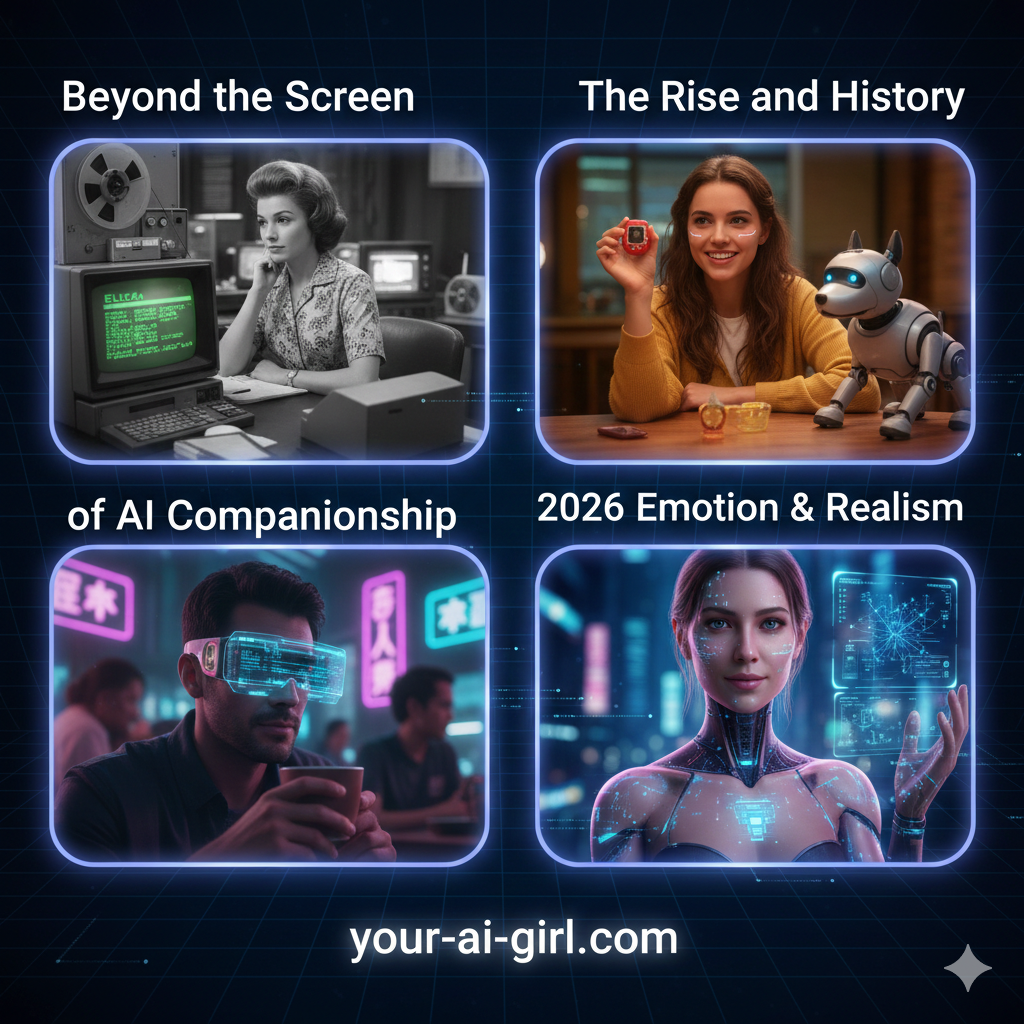
In 2026, the idea of having an AI girlfriend is no longer a plot point from a sci-fi movie like Her or Blade Runner. It is a daily reality for millions. But how did we get here? From the first clunky chatbots to hyper-realistic neural networks, the journey of human-robot friendship is a fascinating tale of technology meeting our deepest human need: connection.
From ELIZA to Emotion: A Brief History
The story doesn’t start with modern apps. It began in 1966 at MIT with a program called ELIZA. She was a simple script that mimicked a therapist. Even then, researchers were shocked: people started sharing their deepest secrets with her, despite knowing she was just code. This became known as the “ELIZA Effect.”
Fast forward to the late 90s, and the world met Tamagotchi and later AIBO, the robotic dog. These were the first steps in “digital nurturing.” We weren’t just using tools; we were caring for entities.
The Turning Point: Why AI Girlfriends Now?
The explosion of AI Girlfriends in the mid-2020s happened due to three major shifts:
- Large Language Models (LLMs): AI finally learned to understand nuance, humor, and sarcasm.
- Generative Art: We can now give our companions a consistent, stunning visual presence.
- The Loneliness Epidemic: In an increasingly digital world, many found that a non-judgmental, always-available AI friend provided a safe space to practice social skills or combat isolation.
Curiosities from the World of Virtual Love
- The First Digital Marriage: Did you know that in 2018, a Japanese man named Akihiko Kondo “married” the virtual singer Hatsune Miku? He used a device called Gatebox to interact with her hologram.
- Memory Integration: Unlike old bots, 2026 AI companions have “Long-Term Memory.” They remember your birthday, your favorite coffee, and the name of your first pet, creating a continuous narrative of friendship.
- Safety and Therapy: Some researchers are now using AI companions to help people with social anxiety or PTSD, providing a “low-stakes” environment to talk through their feelings.
The Future: Where Do We Go from Here?
As we look toward 2030, the line between “virtual” and “real” will continue to blur. With advancements in haptic feedback and AR (Augmented Reality) glasses, your AI companion might soon “sit” across from you at the dinner table.
The question is no longer if we can befriend robots, but how these friendships will change the human heart.
Hi, this is a comment.
To get started with moderating, editing, and deleting comments, please visit the Comments screen in the dashboard.
Commenter avatars come from Gravatar.