
New York Signs AI Chatbot Law for Minors: Jan 1, 2027
Adults only (18+). This article is for information and is not legal advice.
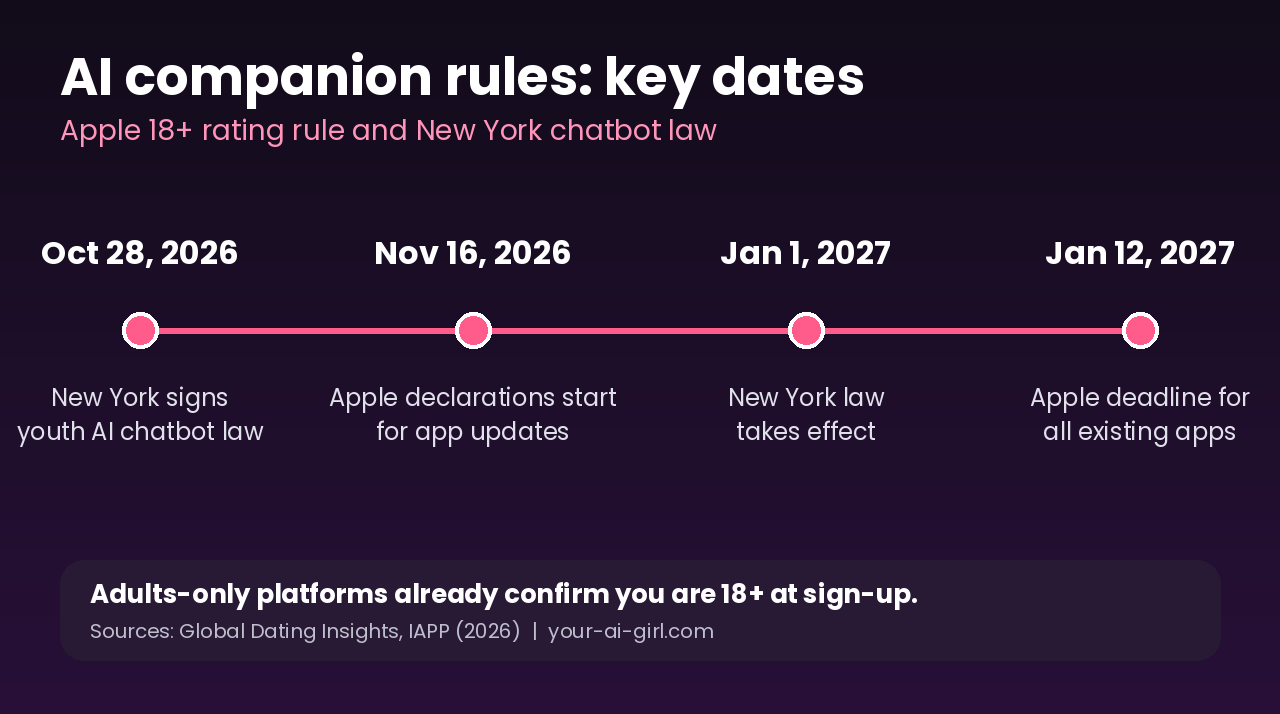
New York has signed one of the strictest laws yet on AI chatbots and children. Governor Kathy Hochul signed the youth AI chatbot safety bill (S.9051B/A.10379C) on October 28, 2026, and it takes effect on January 1, 2027. It targets chatbots offered to minors, including companion-style bots, and it is a signal of where regulation is heading.
What the law requires
- Developers may not design chatbots that pretend to be human, encourage self-harm or hold inappropriate or lewd conversations with children. These are among 12 broad categories of prohibited features.
- Providers must verify users’ ages with multiple methods, at least one of which cannot rely on a government-issued ID.
- Providers must delete the age data after verification.
- The New York Attorney General will run a complaint portal, and violations can cost up to $25,000 each, plus orders such as deleting unlawfully obtained data.
Why companion apps are watching
California was the first state to regulate AI companion chatbots in 2025, and New York now goes further on the youth side. Legal commentators note the categories are “broadly worded and somewhat undefined,” which could create confusion about what counts as a prohibited design. California’s approach differs by adding governance, safety assessments, audits and parental controls.
What it means for adults
- Expect more age verification. Adult-only platforms will keep asking you to confirm you are 18+, and some may add extra checks.
- Privacy matters. Age checks create data. The law’s deletion rule is meant to limit that, but you should still read each service’s privacy notice.
- Adult services stay legal for adults. The law’s focus is minors, not adults who choose an AI companion.
If you are choosing a platform, our Candy AI review explains how age confirmation works at sign-up, and our privacy guide covers what happens to your chats.
Key takeaways
- Signed October 28, 2026; effective January 1, 2027.
- Targets chatbots offered to minors, with age verification and a ban on lewd conversations with children.
- Penalties of up to $25,000 per violation, enforced by the state Attorney General.
- Critics say the wording of the prohibited categories is broad and unclear.
Who has to comply
The law applies to chatbot providers and “covered entities” that offer chatbots to minors. In practice that includes companion-style apps that users can reach from New York. The core obligations are about design (what a chatbot may say and how it may present itself) and about verifying ages without relying only on government ID.
How it compares with other states
California became the first state to regulate AI companion chatbots in 2025, and trackers counted a dozen states with companion chatbot rules by 2026, including laws from New York. According to commentators, California adds governance duties, safety assessments, audits and parental controls, while New York’s new law concentrates on prohibited features and age checks for minors. Our privacy guide explains what this means for the data you share with a companion app.
What to watch next
- Guidance from the Attorney General on how the 12 prohibited categories will be interpreted.
- Company responses. Expect companion apps to add stricter age gates before January 1, 2027.
- Federal action. The FTC opened an inquiry into AI companion chatbots and children in 2025, and Congress has discussed further limits.
Frequently asked questions
Does the law ban AI companions for adults?
No. The focus is on minors. Adult-only services remain legal for adults, and they will likely keep or strengthen their age confirmation.
When does it take effect?
January 1, 2027.
What are the penalties?
Up to $25,000 per violation, plus orders such as deleting unlawfully obtained data.
Does it require a government ID?
No. Providers must verify age with multiple methods, at least one of which cannot rely on a government-issued ID, and they must delete the age data after verification.
Sources: IAPP: New York youth AI chatbot safety bill · Orrick: 2026 state chatbot laws