
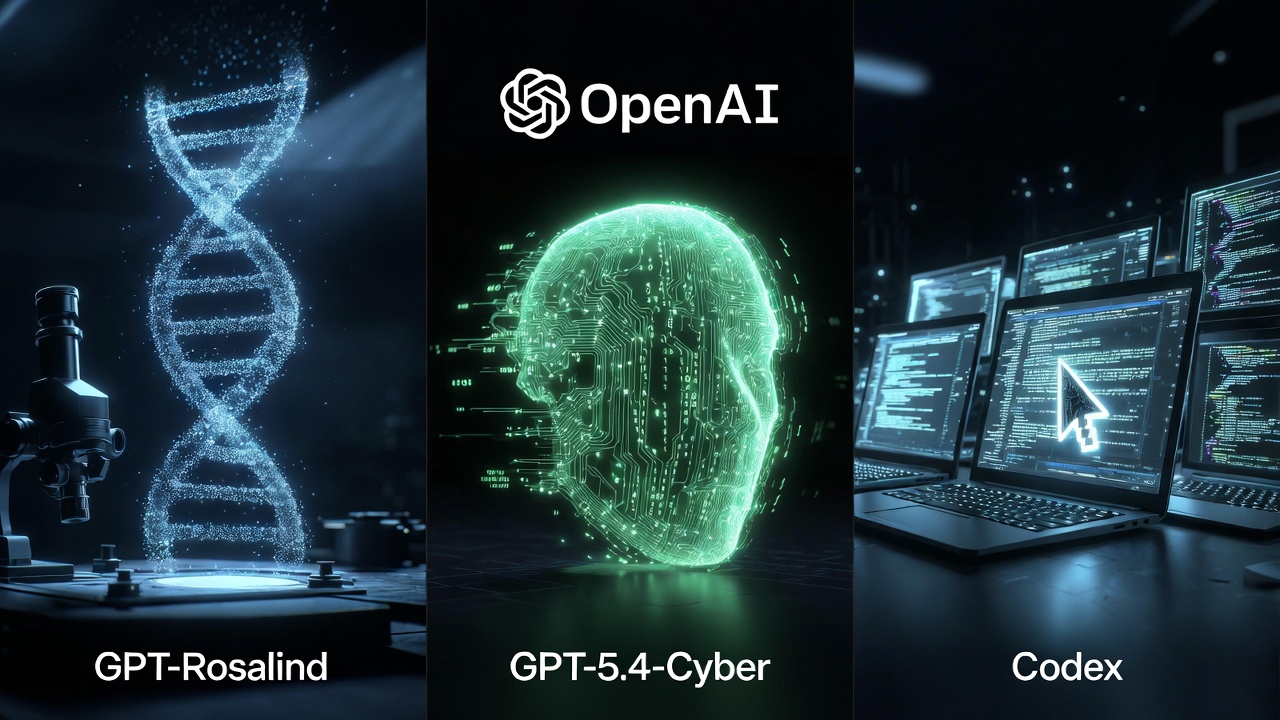
OpenAI launched GPT-Rosalind for drug discovery, GPT-5.4-Cyber for security, and Codex for everything. Here’s what it means for AI companions and your health — April 2026.
This week, OpenAI didn’t just release a product update. It released a signal about where AI is heading — and it matters directly to anyone using an AI companion for emotional support, health questions, or mental well-being.
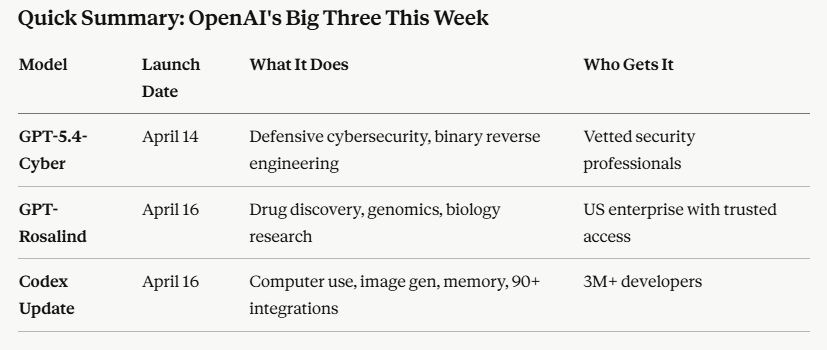
In a three-day sprint from April 14 to April 16, 2026, the company launched GPT-5.4-Cyber, GPT-Rosalind, and a sweeping update to Codex. Taken together, these three announcements mark OpenAI’s clearest move yet away from one-size-fits-all AI and toward specialized models designed for the most sensitive, high-stakes domains imaginable: your health, your security, and your daily workflow.
Here’s what happened — and why users of AI companions should be paying close attention.
GPT-Rosalind: The AI That Could Change Every Drug You Take
OpenAI designed its first Life Sciences model — GPT-Rosalind — to be better at fundamental reasoning in fields like biochemistry and genomics. The company says the model won’t replace scientists, but rather help them move faster through some of the most time-intensive and analytically demanding work of the scientific process. Axios
GPT-Rosalind is named after Rosalind Franklin, the British chemist and X-ray crystallography pioneer whose research helped reveal the structure of DNA. It is designed to help researchers with the early stages of drug discovery by making tasks such as evidence synthesis, hypothesis generation, and experimental planning quicker and more efficient. pharmaphorum
The problem it’s solving is enormous:
It currently takes roughly 10 to 15 years to go from target discovery to regulatory approval for new drugs in the United States. Only one in 10 drugs entering clinical trials ultimately gets approved. More than 30 million Americans and 300 million people globally living with rare diseases are waiting for better treatments. Axios
What GPT-Rosalind Actually Does
Researchers can use the model to handle complex, multi-step scientific tasks — from gathering existing evidence and forming new hypotheses to planning experiments. OpenAI is working with customers including Amgen, Moderna, the Allen Institute, and Thermo Fisher Scientific to apply the model in discovery workflows. Quartz
GPT-Rosalind is built to work across biological research tasks within a single interface. It can query specialized databases, parse scientific literature, interact with computational tools, and suggest new experimental pathways — not as a clunky sequential handoff, but as an orchestrated, multi-step workflow. The key tasks include evidence synthesis, hypothesis generation, experimental planning, sequence-to-function prediction, molecular cloning design, and literature retrieval and interpretation. AI Revolution
OpenAI is also releasing a free Life Sciences research plugin for Codex, which gives scientists access to more than 50 scientific tools and data sources across human genetics, functional genomics, protein structure, biochemistry, clinical evidence, and public study discovery. pharmaphorum
The Benchmarks Are Striking
GPT-Rosalind achieved a pass@1 score of 0.751 on BixBench — a comprehensive bioinformatics benchmark — ahead of GPT-5.4 (0.732), GPT-5 (0.728), Grok 4.2 (0.698), and Gemini 3.1 Pro (0.550). On LABBench2, a 2026 benchmark spanning nearly 1,900 biology research tasks, GPT-Rosalind beat GPT-5.4 on 6 of 11 task families. Nerdleveltech
In an evaluation with gene therapy company Dyno Therapeutics, the model’s best ten submissions ranked above the 95th percentile of human experts on an RNA sequence prediction task. Quartz
The Market Just Reacted
After the news about GPT-Rosalind, shares of several drug discovery companies dropped sharply. Recursion Pharmaceuticals and Schrodinger each lost more than 5% of their value. IQVIA Holdings fell by up to 3.2%, and Charles River Laboratories dropped by 2.6%. Quartz
Wall Street just told you how significant this is.
Who Gets Access — and the Biosecurity Question
GPT-Rosalind is not publicly available. It operates through a trusted access program, limited to qualified enterprise customers in the United States. Organizations need to demonstrate they are working toward improving human health outcomes, conducting legitimate life sciences research, and maintaining strong security and governance controls. AI Revolution
The reason for the gating isn’t bureaucracy — it’s biology risk.
The rollout comes as researchers warn that AI models trained on biological data could be misused to help design dangerous pathogens. Axios
OpenAI has controls for eligibility, access, and governance. The system watches for signs of bioweapons concerns and triggers what the company calls “high-precision flags” if certain thresholds are reached. Quartz
The Competition Is Already Here
The launch came only two days after Amazon unveiled its own AI-powered drug discovery platform — Amazon Bio Discovery — to compete with systems from NVIDIA, Alphabet’s Isomorphic Labs, and Anthropic, all designed to reduce the time from target discovery to the clinic. pharmaphorum
The distinction worth understanding: Isomorphic Labs sells outcomes — it’s a pharma co-development partner. GPT-Rosalind sells access — it’s a tool that enterprise biologists can wire into their own pipelines. Chai Discovery occupies a third position, shipping antibody-specific generative models and running its own wet-lab validation. A serious drug-discovery team in 2026 will likely use more than one of these. Nerdleveltech
GPT-5.4-Cyber: The AI Trained to Hack Defenses Back
Two days before GPT-Rosalind, OpenAI launched something aimed at an entirely different kind of safety.
OpenAI unveiled GPT-5.4-Cyber, a variant of its latest flagship model GPT-5.4, specifically optimized for defensive cybersecurity use cases — arriving days after rival Anthropic unveiled its own frontier model, Mythos. The Hacker News
GPT-5.4-Cyber lowers the refusal boundary for legitimate cybersecurity work and enables new capabilities for advanced defensive workflows, including binary reverse engineering — allowing security professionals to analyze compiled software for malware potential, vulnerabilities, and security robustness without needing access to source code. OpenAI
This matters for AI companion users because the worst data breaches in this industry — including the 300 million messages exposed in February 2026 — happened precisely because the apps had weak security foundations. A world where defensive security professionals have access to more powerful AI means those vulnerabilities get found and patched faster.
Codex Security, which launched in private beta six months ago, has contributed to over 3,000 critical and high fixed vulnerabilities since its recent broader launch. OpenAI
OpenAI is scaling its Trusted Access for Cyber program to thousands of verified individual defenders and hundreds of teams. Users approved for the highest tier gain access to GPT-5.4-Cyber, which has fewer restrictions on sensitive cybersecurity tasks such as vulnerability research and analysis. Axios
Capture-the-flag benchmark performance across OpenAI’s models improved from 27% on GPT-5 in August 2025 to 76% on GPT-5.1-Codex-Max in November 2025. SiliconANGLE
Codex for (Almost) Everything: AI Takes Over Your Computer
On April 16, OpenAI released a major update to Codex, making it a more powerful partner for the more than 3 million developers who use it weekly. Codex can now operate your computer alongside you, work with more of the tools and apps you use every day, generate images, remember your preferences, learn from previous actions, and take on ongoing and repeatable work. OpenAI
The headline feature is Background Computer Use: multiple AI agents running simultaneously with their own cursors, working in the background while you continue your own work uninterrupted.
The April 16 update materially shifts the coding-agent landscape. Codex has absorbed capabilities that previously belonged to other products — specifically desktop control and visual iteration. But the design choice is parallel background operation: several agents can hold their own cursors and work simultaneously. That unlocks workflows like running one agent through a QA pass while another fills out a CRM while a third follows up on support tickets, with the developer continuing their own work unaffected. Digital Applied
What This All Means for AI Companion Users
Three specialized AI systems in one week. Here’s the connection that most tech coverage is missing:
The line between AI companion and AI health tool is disappearing.
Your Replika, your Nomi AI, your AI girlfriend — they already handle your emotional disclosures. They already know more about your mental state than most people in your life do. They’re already the first place millions of people turn with health questions, relationship anxiety, and daily stress.
Now OpenAI is building AI that can reason at the level of expert human biologists and security researchers. That same reasoning capability will flow downstream — into the companion apps you use, the wellness tools on your phone, the chatbot your therapist’s office uses to do intake assessments.
The question “is my AI companion giving me good mental health support?” is about to become “is my AI companion practicing unlicensed medicine?” — and the line between those two questions is narrower than anyone is comfortable admitting.
OpenAI stresses that these new models are designed to synthesize evidence, generate hypotheses, and support analysis — not replace expert judgment or real-world validation. Humans, they say, still belong in the loop. Axios
That’s true for GPT-Rosalind, deployed to vetted pharmaceutical companies with strict access controls.
It’s less clear when the same underlying capabilities reach the AI girlfriend app you downloaded for free last Tuesday.
The Bigger Picture: OpenAI’s Vertical AI Strategy
For three years, the dominant AI playbook has been to scale up one model and let it do everything. That scaling curve is flattening in terms of benchmark returns. The next performance gains increasingly come from specialization: models fine-tuned with domain-specific data, evaluated against domain-specific benchmarks, and integrated with domain-specific tooling. Life sciences is the clearest proving ground for this thesis because the stakes are enormous, the domain knowledge is deep and verifiable, and the gap between what a general model can do and what a specialized one can do is large. AI Revolution
GPT-Rosalind for biology. GPT-5.4-Cyber for security. Future models for mental health support, for legal advice, for financial guidance.
OpenAI said this is “the first release in our Life Sciences model series, and we view it as the beginning of a long-term commitment to building AI that can accelerate scientific discovery in areas that matter deeply to society, from human health to broader biological research.” pharmaphorum
The era of one AI that does everything is ending. The era of specialized AI that knows more than human experts in specific domains is beginning.
And when that specialization reaches mental health, emotional support, and intimate companionship — the AI companion industry will never look the same.
What do you think — should AI companion apps be held to the same standards as medical devices? Drop a comment below. 💬
Want weekly updates on AI health, AI law, and the future of AI companions? Subscribe to our newsletter — every Monday, the most important stories straight to your inbox ❤️