
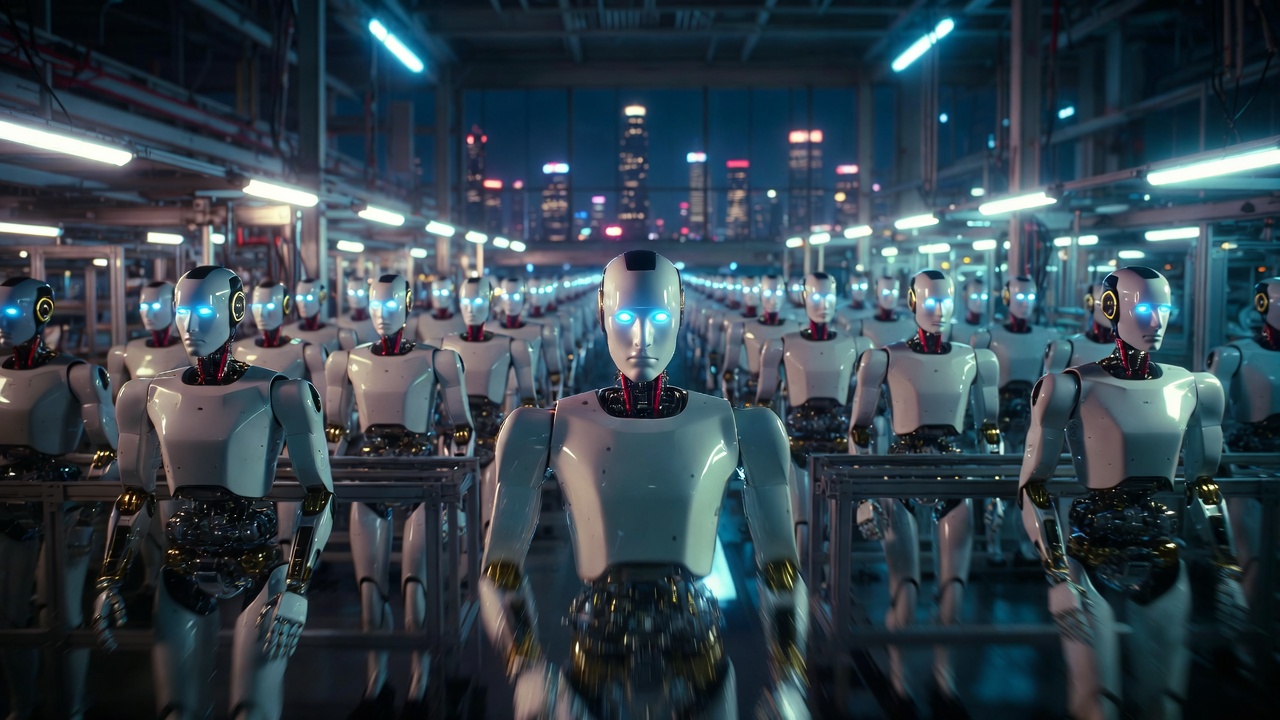
While the US and Europe debate regulation, publish white papers, and hold congressional hearings about artificial intelligence — China is shipping robots.
Real ones. By the thousands. To factories, hotels, hospitals, and shopping malls across six continents.
The numbers coming out of April 2026 tell a story that most Western media is still sleeping on: China now controls roughly 90% of the global humanoid robot market. And the gap is widening every month.
The Milestone That Changed Everything: Agibot’s 10,000th Robot
On March 30, 2026, Agibot announced a major achievement — rolling out its 10,000th humanoid robot in Shanghai. This makes it one of the first robotics companies in the world to reach such a scale. Gizmochina
But the number itself is less interesting than the speed at which it happened.
It took nearly two years to produce the first 1,000 robots. The jump from 1,000 to 5,000 units took about one year. The jump from 5,000 to 10,000 was completed in just three months — a more than fourfold acceleration in production speed. The Manila Times
This is what exponential manufacturing looks like. Not in a slide deck. In reality.
“Reaching 10,000 units is not simply about producing more robots — it reflects a fundamental shift in our ability to scale,” said Peng Zhihui, CTO of Agibot. “As our supply chain matures and manufacturing standardizes, we are seeing a pivot from small-scale, niche applications to robust, large-scale commercial demand. The widespread deployment of our robots is no longer about seeking technical viability, but about delivering scalable value and driving the adoption of embodied AI.” Robotics Tomorrow
Where Are These Robots Actually Working?
Agibot’s solutions are now deeply integrated into logistics, showroom navigation, retail, and hospitality services, as well as the education industry. Beyond service-oriented roles, its robots have begun entering industrial workflows, operating directly on production lines to support manufacturing tasks. Robotics Tomorrow
One car-parts producer, Fulin Precision, has deployed nearly 100 Agibot robots to perform repetitive manual tasks including loading and unloading materials and moving boxes and parts. China Mobile deployed others in around 50 pop-up stores and 30 service centers across 22 cities, acting as receptionists and ticket distributors. DirectIndustry e-Magazine
This momentum extends far beyond the Chinese domestic market. Driven by robust international demand, a substantial number of these 10,000 units are being deployed across Europe, North America, Japan, South Korea, Southeast Asia, and the Middle East. Robotics Tomorrow
The Scorecard: China vs. the World
Chinese companies accounted for nearly 90% of global humanoid robot shipments in 2025. Unitree and Agibot shipped more than 10,000 robots combined, far ahead of every other manufacturer. Tesla, Figure AI, and Agility Robotics each shipped about 150 units — showing how early the US market still is. Visual Capitalist
Let that land for a moment.
China shipped 14,500+ humanoids in 2025, while US firms shipped approximately 150 units each. It’s not just a gap — it’s a chasm that exposes hard truths about who owns the supply chains and production scale needed to win this category. Theresarobotforthat
According to industry analysts, Unitree and Agibot alone accounted for 81% of global humanoid robot shipments in 2025. Taking into account other Chinese manufacturers — Galbot, UBTech, EngineAI, and Leju Robot — China’s total market share reaches approximately 90%. Verdict
Why China Is So Far Ahead
China’s early advantage is due to “a combination of policy support, public investment, mature supply chain, and advancements made in AI software and hardware,” according to Lian Jye Su, chief analyst at tech consultancy Omdia. Rest of World
Even Elon Musk himself acknowledged it. “China is very good at AI, very good at manufacturing, and will definitely be the toughest competition for Tesla,” Musk said at the World Economic Forum. “To the best of our knowledge, we don’t see any significant competitors outside of China.” Rest of World
China already dominated 54% of global industrial robot installations in 2024 — its domestic manufacturers sold more robots domestically than foreign suppliers for the first time, with domestic market share jumping to 57% in 2024 from 47% in 2023. The humanoid boom is built on that foundation. DirectIndustry e-Magazine
Unitree: The $610 Million IPO That Could Change Everything
While Agibot made headlines with its 10,000-unit milestone, its rival Unitree just made a move that signals even bigger ambitions.
Hangzhou-based Unitree Robotics filed for an initial public offering on the Shanghai Stock Exchange on March 20, 2026, seeking to raise 4.2 billion yuan — approximately $610 million. The company became the world’s top humanoid robot seller in 2025. Rest of World
The IPO prospectus reveals remarkable financial health for a company in what most Western analysts still treat as a pre-commercial industry:
Unitree’s operating income grew 335% year-on-year in 2025, reaching 1.708 billion yuan, while its net profit soared by 674%. Humanoids became the firm’s key growth engine, rising to 51.5% of main business revenue in the first three quarters of 2025. CNBC
In 2023, the average price of Unitree’s humanoid robots was around $85,000. Last year, it fell to $25,000. But even with prices dropping, the company’s gross margin improved to nearly 60%. Unitree said it self-develops and manufactures core components, giving it a significant cost advantage. Rest of World
And this week, Unitree made its most aggressive international move yet.
Unitree began selling its cheapest humanoid robot directly on Alibaba’s AliExpress on April 15, 2026. The R1 model costs roughly $8,150 with import fees, with free shipping to the US. Markets served include the US, Canada, Japan, the UAE, and Singapore. Bloomberg
A humanoid robot. $8,150. Delivered to your door from China. Free shipping.
Hong Kong, April 18: Robots Perform Kung-Fu at the World’s Biggest Electronics Show
The cultural signal came this week, and it was impossible to ignore.
On April 18, 2026, Phase II of the Global Sources Hong Kong Shows opened at AsiaWorld-Expo — the first time in the show’s history that it featured a dedicated Humanoid Robot Zone. Unitree robots performed kung-fu and dance demonstrations live on the show floor, showcasing advanced capabilities in motion planning and real-time interaction. PR Newswire
The show brought together over 2,000 quality suppliers across nearly 4,000 booths and showcased approximately 150,000 new products. Pre-registered global buyers grew 35% year-on-year, with particularly strong increases from Eastern Europe, Western Europe, the United States, and ASEAN. PR Newswire
The buyers from the US and Europe are not coming to watch. They’re coming to buy.
Washington Panics: The American Security Robotics Act
The speed of China’s advance has finally triggered a bipartisan response in Washington — something almost nothing else achieves in 2026.
Republican Senator Tom Cotton and Democratic Senate Minority Leader Chuck Schumer introduced the American Security Robotics Act, which seeks to ban the US federal government from purchasing and operating Chinese-made unmanned ground vehicle systems, including humanoid robots. The Hill
Schumer said: “The Chinese Communist Party has shown that they are willing to lie and cheat to get ahead at the expense of the American people and our national security. They are running their standard playbook — this time in robotics — trying to flood the US market with their technology, which presents real security risks and threats to Americans’ privacy and American research and industry.” The Hill
The concern is not just what these robots can do. It’s what they could be doing behind the scenes. Lawmakers say these systems are already being marketed to US research labs, universities, law enforcement agencies, and consumers. Fox News
The bill would also restrict the use of federal funds for unmanned ground vehicles from adversary nations, citing concerns over data security and remote access risks. The legislation includes limited exemptions for military and law enforcement research. AI Insider
Notably, Agibot directly acknowledged the legislation in its milestone announcement, noting that US lawmakers have proposed prohibiting federal purchase or use of certain Chinese-made robots over cybersecurity concerns. The Robot Report
China’s Spring Festival Gala: A Sputnik Moment Nobody in the West Watched
One episode from early 2026 captures the scale of what’s happening better than any market report.
China’s humanoid robotics industry had its Sputnik moment during the 2026 Spring Festival Gala — the world’s most-watched television program, broadcast on Chinese New Year’s Eve. Humanoid robots performed perfectly choreographed kung-fu, stunning hundreds of millions of viewers. Whereas the models a year earlier could barely stand, the latest cohort performed with dexterity that left audiences across China speechless. DirectIndustry e-Magazine
In 1957, the Soviet Union launched Sputnik. America watched a beeping satellite pass overhead and felt, for the first time, genuinely behind. The US responded with NASA, massive science education investment, and eventually the Moon landing.
In 2026, China put humanoid robots with swords and nunchucks on the world’s most-watched TV show. Most Americans didn’t see it.
The Market Scale — and What $5 Trillion Looks Like
Morgan Stanley Research estimates the humanoids market is likely to reach $5 trillion by 2050. There could be more than 1 billion humanoids in use by that date — roughly 90% used for industrial and commercial purposes. China is likely to have the highest number of humanoid robots in use by 2050, at 302.3 million, trailed by the US at 77.7 million. Morgan Stanley
In 2025, funding for humanoid robot manufacturers in China surpassed $1 billion. Investors include Alibaba, Bosch, CATL, Geely, JD.com, Tencent, and XPeng. In 2026, PsiBot raised $280 million and Robotera another $140 million — both in March alone. Verdict
Unitree is targeting a $7 billion valuation on Shanghai’s STAR market, and Agibot is aiming for a $6 billion valuation on the Hong Kong stock exchange. Verdict
What This Means for Physical AI Companions
Here’s the question this site cares most about — and it’s one nobody is asking loudly enough.
The robots performing kung-fu in Hong Kong this week, the 10,000 Agibot units deployed in logistics and retail, the $8,150 Unitree robot now available to order on AliExpress — these are not just industrial machines. They are the hardware foundation for the next generation of AI companions.
The AI girlfriend and boyfriend apps you use today are digital. Text. Voice. A screen. The physical AI companion — a robot that recognizes your face, remembers your preferences, learns your routines, and can physically act in your home — that product is being built right now. And 90% of the companies building it are Chinese.
The American Security Robotics Act bans federal agencies from buying these robots. It says nothing about private consumers.
Which means the first humanoid companion robot that millions of Americans bring into their homes could very well be manufactured in Hangzhou, running software developed in Shanghai, with data potentially flowing to servers in Beijing.
The US government just noticed. The question is whether it noticed in time.
Timeline: China’s Robot Dominance at a Glance
| Date | Event |
|---|---|
| 2025 Full Year | 14,500+ humanoid robots shipped globally; China: ~90% |
| Jan 2026 | Agibot hits 5,100 units, debuts at CES; Unitree debuts G1 at Spring Festival Gala |
| Mar 20, 2026 | Unitree files $610M IPO on Shanghai Stock Exchange |
| Mar 26, 2026 | US senators introduce American Security Robotics Act |
| Mar 30, 2026 | Agibot announces its 10,000th humanoid robot |
| Apr 15, 2026 | Unitree lists R1 robot on AliExpress for $8,150 — free US shipping |
| Apr 18–21, 2026 | First-ever Humanoid Robot Zone at Global Sources Hong Kong Show |
The Bottom Line
China isn’t winning the humanoid robot race. China has already won the first lap — by an enormous margin. The question now is whether Western companies can compete in the second lap, or whether they’ll be building robots that cost three times as much, ship three years later, and face a supply chain that China already dominates.
Elon Musk is spending every Saturday working on Tesla’s AI5 chip. OpenAI just launched GPT-Rosalind to accelerate biological research. The US Congress is writing laws.
Meanwhile, a robot that does kung-fu is performing live in Hong Kong today.
And you can order one for the price of a used car. Free shipping included.
Should the US government ban Chinese humanoid robots from private consumers — not just federal agencies? Drop a comment below. 💬
Want weekly updates on physical AI, humanoid robots, and the future of AI companions? Subscribe to our newsletter — every Monday, the most important stories straight to your inbox ❤️